
Gabriella’s Botanical Library
Frankincense — there is more than one sacred tree
Frankincense is not a single plant or one fixed aroma. It is the fragrant resin of several Boswellia trees, shaped by species, landscape, harvest and distillation.
The material
What is frankincense?
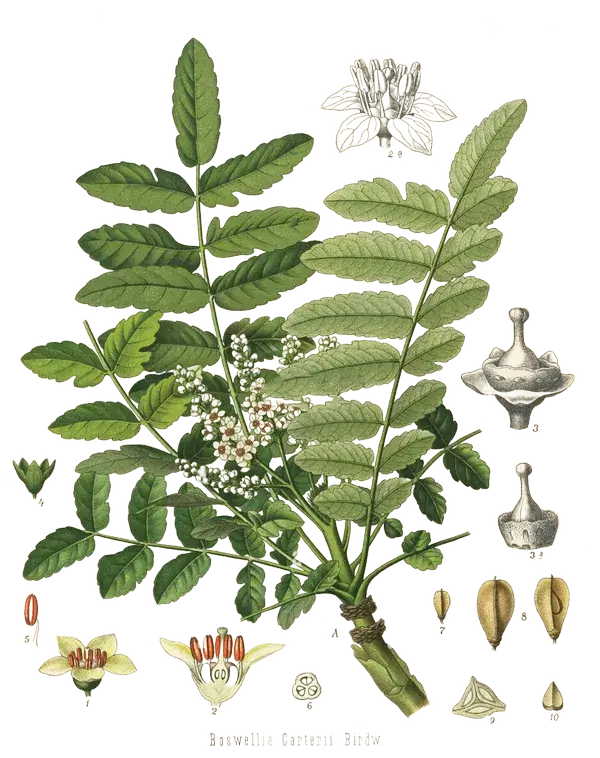
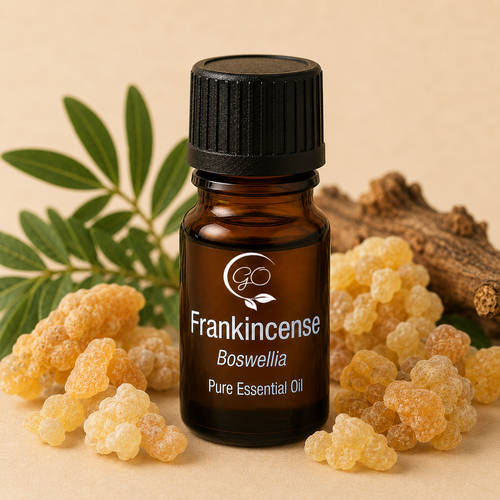
Frankincense begins as resin. When the bark of a mature Boswellia tree is carefully tapped, a milky exudate appears and gradually hardens into translucent or golden tears. Those tears may be burned as incense, extracted, or steam distilled to produce essential oil.
The word therefore describes a family of materials rather than one universal product. Resin from different trees can be pale or dark, citrus-bright or balsamic, dry and mineral or warm and woody. Distillation captures the more volatile aromatic fraction, so frankincense essential oil does not smell exactly like resin burning on charcoal.
Frankincense is the resin; frankincense essential oil is its distilled aromatic fraction. The heavier boswellic acids associated with resin extracts are not significant volatile components of the essential oil.
The Boswellia family
Several trees, several expressions
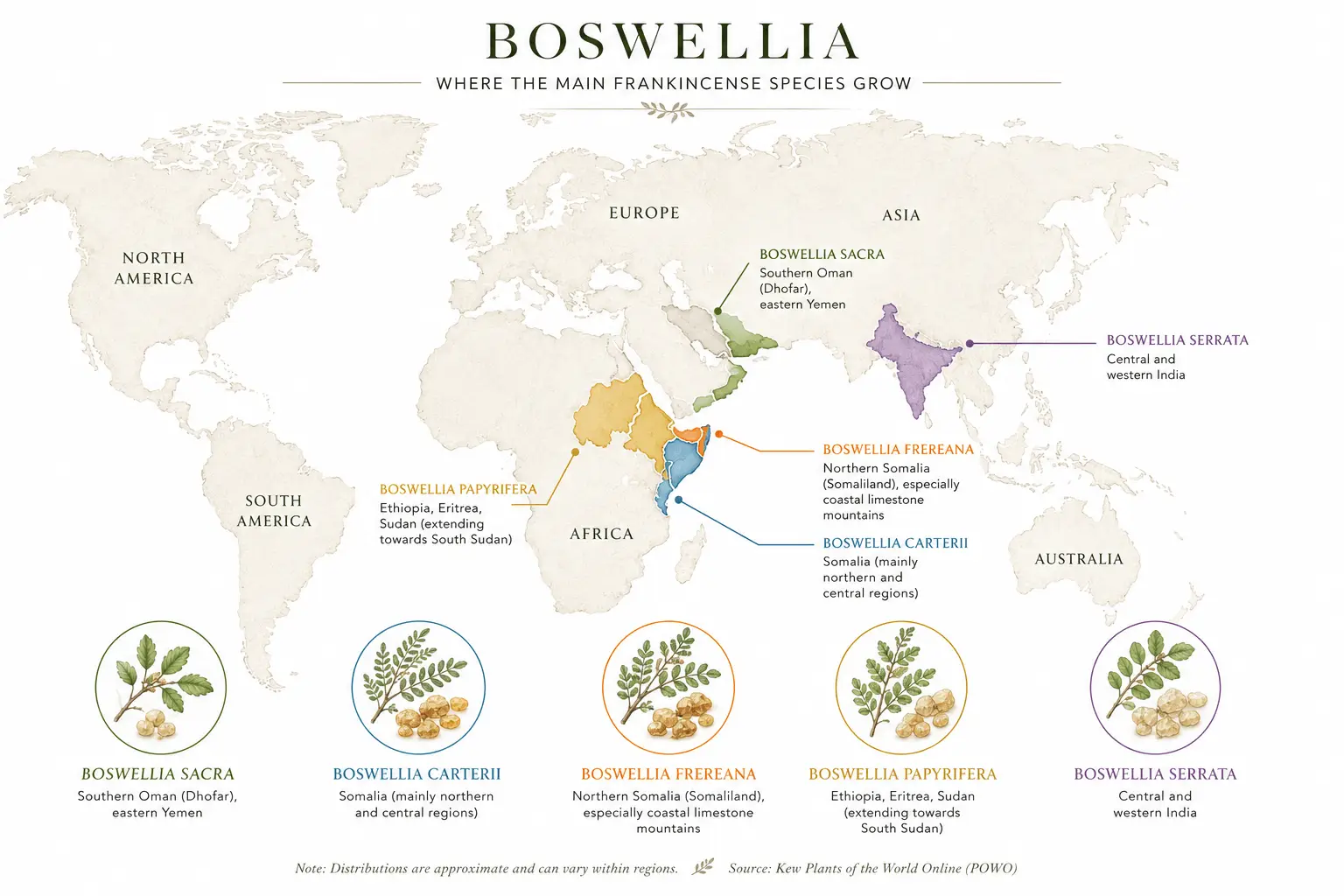
Around twenty Boswellia species are currently recognised, although only a smaller group supplies most internationally traded frankincense. Names are not always used consistently: Boswellia carterii remains common in aromatherapy and trade, while many modern botanical authorities treat it as a synonym of Boswellia sacra.
Boswellia sacra
Associated with: Oman, Yemen and parts of the Horn of Africa.
Often bright, diffusive and dry, with lemon-peel, pine, green and faintly mineral facets. Omani resins are especially celebrated, but grade and distillation still matter.
Boswellia carterii
Common trade name: Somali frankincense.
Frequently encountered on essential-oil labels. Depending on the botanical authority and supplier, the name may refer to B. sacra, a regional form, or a long-established commercial identity.
Boswellia frereana
Associated with: northern Somalia; traditionally called Maydi.
Often smoother, warmer and less sharply terpenic than the most citrus-led frankincense oils, with soft wood, resin and balsamic nuances. Much of the resin is prized for chewing as well as incense.
Boswellia serrata
Associated with: India.
Commonly described as earthier, drier and more woody-spiced. It has an important place in Indian incense traditions and in resin extracts used in herbal preparations.
Boswellia papyrifera
Associated with: Ethiopia, Eritrea and Sudan.
A major source of internationally traded resin. Its forests are central to current sustainability concerns because ageing stands often show poor natural regeneration.
A species name is useful, but it cannot predict a bottle perfectly. Soil, rainfall, resin grade, storage, distillation and whether harvests have been combined all influence the finished aroma.
Sacred smoke and ancient trade
Which frankincense was used in the Bible?
The honest answer is that no surviving label identifies a single botanical species. Biblical texts name frankincense as an incense material, not according to modern plant taxonomy. Resin reached the Levant through extensive trade networks connecting southern Arabia, the Horn of Africa, Egypt and the Mediterranean.
Boswellia sacra is often promoted as “Biblical frankincense”, and it is certainly a plausible historic source. That does not prove it was the only source. Resins from different districts could be graded, traded together and renamed as they passed through ports and markets.
There is no single protected “original Biblical tree”. The more accurate story is that several frankincense-producing landscapes survive, each with its own trees, harvesters and traditions.
Why the material became precious
Frankincense travelled well, burned slowly and transformed the atmosphere of a room. It was used in ritual, burial, domestic fumigation, medicine and perfumery. Its value came not only from rarity, but from the labour and distance involved in bringing resin from remote drylands to wealthy cities.
From bark to resin tear
How frankincense is harvested
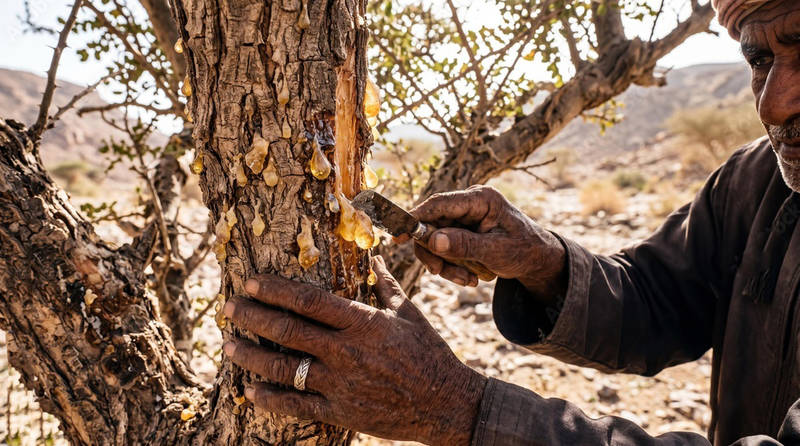
A harvester makes a controlled incision in the outer bark. The tree seals the wound with resin, which is left to harden before collection. A tree may be revisited during the season, with later tears sometimes becoming cleaner and more highly graded.
Tapping is not automatically harmful. Problems arise when trees are cut too deeply, too often, at too young an age, or without adequate rest. Fire, grazing, drought, land conversion, pests and poor seedling survival can compound the pressure.
Responsible practice: shallow controlled cuts, suitable mature trees, limited tapping rounds, rest periods and long-term woodland management.
Damaging practice: deep wounds, excessive cuts, continuous tapping and harvesting that ignores tree condition or regeneration.
Is frankincense protected?
Protection varies by species and country; there is no simple worldwide ban on frankincense. Some populations are stable, while others are declining or poorly regenerating. A sustainable supply depends on traceability, fair value for harvesters and care for the whole woodland—not merely buying a resin described as rare or sacred.
Natural variation
Why suppliers may blend trees or harvests
A frankincense oil may be made from one named species, from several resin grades, or from pooled harvests gathered across a wider region. Blending can be used to make a recognisable aromatic profile when individual harvests naturally vary.
- Consistency: balancing bright, woody and resinous batches from season to season.
- Availability: maintaining production when one district has a smaller harvest.
- Traditional trade: resin has long been sorted by appearance and grade as well as modern species identity.
- Cost: premium grades and origins command different prices, so transparent labelling matters.
A blend is not inherently inferior. The important questions are whether the supplier knows what it contains, describes it honestly and can explain where and how the resin was sourced.
The perfumer’s material
Frankincense in natural perfumery
Frankincense behaves unlike a dense, sweet resin. Its essential oil can open with remarkable lift—lemon peel, green pine and cool air—before revealing dry wood and soft incense. This gives it the ability to connect the top, heart and base of a composition.
It can brighten heavy balsams, give space to florals, polish rough woods and create the impression of smoke without making a perfume smell charred. In small amounts it may be almost invisible, working as structure rather than as an obvious church-incense note.
What frankincense blends with
Resins
Myrrh, Benzoin, Tolu Balsam and Cistus deepen its warmth and extend the dry-down.
Woods
Sandalwood, Cedarwood and Amyris give body to its dry, transparent woodiness.
Citrus
Bergamot, Sweet Orange, Green Mandarin and Yuzu echo its sparkling opening.
Florals
Rose, Jasmine, Lotus and Ylang Ylang become more spacious and less overtly sweet.
Herbs
Lavender, Roman Chamomile and Basil Linalool bring aromatic freshness and clarity.
A note on chemistry
Frankincense oils commonly contain volatile terpenes such as α-pinene, limonene and other monoterpenes, but proportions vary dramatically by species and sample. Chemistry can help explain why one oil is pine-bright and another softer or more balsamic; it should not be reduced to one “signature molecule”.
A simple aromatic study
Golden Resin
Frankincense, Myrrh, Sweet Orange, Australian Sandalwood and Benzoin
The impression
Bright resin at first, then warm woods and a softly sweet amber finish. Orange illuminates the natural citrus facet of Frankincense; Myrrh brings shadow, while Sandalwood and Benzoin smooth the transition into the base.
Concentrate formula
- Frankincense
- 35%
- Sweet Orange
- 25%
- Australian Sandalwood
- 20%
- Myrrh
- 10%
- Benzoin
- 10%
Use as an aromatic study: this is a concentrate ratio, not a finished skin product. Dilute appropriately for the intended use and check the safety information for every material.
Frequently asked questions
Choosing and understanding frankincense
Which frankincense is the “real” one?
Several Boswellia species produce genuine frankincense. “Real” should describe authentic resin from a correctly identified tree—not one privileged species used to dismiss all others.
Are Boswellia carterii and Boswellia sacra the same?
Many current botanical databases treat B. carterii as a synonym of B. sacra. The name remains widespread in commerce, and suppliers do not always use it in exactly the same way.
Which type is best for perfume?
That depends on the composition. A bright, terpenic oil can lift citrus and florals; a warmer, softer oil may sit more naturally with woods, amber and balsams.
Why does my oil not smell like church incense?
Steam distillation and burning reveal different parts of the resin. Church incense may also be a compound blend containing several resins, woods, spices or added fragrance.
Does frankincense essential oil contain boswellic acids?
Boswellic acids are heavy, non-volatile resin constituents and are not present in meaningful amounts in properly distilled essential oil. Claims about resin extracts should not automatically be transferred to the oil.
Explore further
Shop and related reading
Discover Frankincense itself, or continue through the Botanical Library.
Gabriella’s Botanical Library
Natural materials are rarely just one thing
Species, landscape, harvest and processing all change how a botanical material smells and behaves. This library is here to make those differences easier to understand.
Browse the Botanical Library